Phoenix Pool Inspection Checklist Before Buying a Home
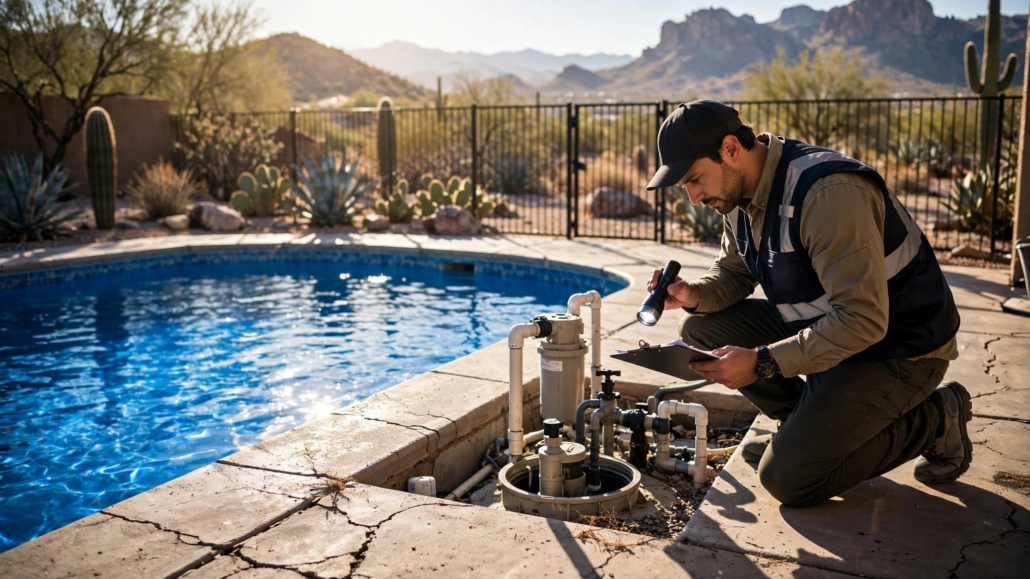
A Phoenix pool inspection can save you from buying a beautiful backyard with an ugly repair bill hiding behind the pump pad. That matters when you’re deciding whether to make an offer or proceed to closing.
When considering a property in Phoenix, a thorough Phoenix pool inspection becomes essential, as it can uncover hidden issues that could lead to expensive repairs later.
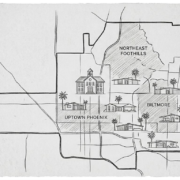
In the Phoenix metropolitan area, a swimming pool is a major home system in the desert. It’s a big part of life in Arcadia, Biltmore, the Sheaborhood, and Scottsdale’s 85254, but it also operates in brutal heat.
Understanding the intricacies of a Phoenix pool inspection can help you make informed decisions about your home purchase.
I’ve helped plenty of buyers fall in love with the water, patio, and mountain view. Then we look closer. Cracked decking, tired equipment, loose fencing, and a heater that’s been “working fine” since 2009 can change the conversation fast.
A comprehensive Phoenix pool inspection can help identify these issues before you commit to the purchase.
You don’t have to be an expert. You do need a careful inspection period and the right questions.
Having a reliable Phoenix pool inspection ensures you don’t overlook critical aspects of the pool’s condition.
Key takeaways
Remember, a Phoenix pool inspection can provide peace of mind regarding your investment.
-
- A general home inspection is important, but a dedicated pool inspection may reveal problems it doesn’t cover.
Prioritize a Phoenix pool inspection to avoid unexpected surprises.
-
- Check the shell, decking, plumbing, equipment, water quality, and safety features, including interior barriers, gates, and electrical protection, before your inspection deadline expires.
After your Phoenix pool inspection, address any repairs identified during the review.
-
- Confirm the required safety parameters. Phoenix requires a non-climbable fence at least five feet high, with gates that are self-closing and self-latching.
Ensure your buyer’s agent understands the importance of a thorough Phoenix pool inspection.
-
- A clean-looking pool can still have a leak, failing pump, aging heater, or costly electrical repair.
It’s wise to schedule your Phoenix pool inspection as soon as possible.
-
- Confirm whether spa inspections, fountains, slides, heaters, salt systems, and leak checks are included in the written scope. Don’t assume.
Consider any factors that could influence your Phoenix pool inspection results.
-
- Keep your inspection contingency when possible. Address repairs during negotiations, because closing first can turn a manageable issue into a costly surprise.
Obtaining a detailed Phoenix pool inspection report helps guide your negotiations.
Utilize the Phoenix pool inspection to your advantage in negotiating repairs or credits.
Put the pool inspection inside the bigger due-diligence plan
Incorporating your Phoenix pool inspection findings into your overall plan is vital.
Treat the pool inspection as one step in your broader home-buying due diligence. A pool can be an expensive part of the property.
Make sure your Phoenix pool inspection includes all necessary assessments.
Look at the roof, HVAC, electrical panel, sewer line, past water damage, and equipment together. A detailed Phoenix home inspection guide helps you keep the entire property in view. A home can have a great pool and still need a new air conditioner two months after closing. Phoenix summers don’t care about your moving budget.
Discuss the Phoenix pool inspection with your real estate team to ensure clarity.
Read the seller disclosure before the inspection
Choose a qualified inspector who specializes in Phoenix pool inspections for the best results.
Start with the seller’s property disclosure statement. Look for leak history, resurfacing dates, equipment age, warranties, drainage work, repairs, and prior electrical work.
Make your Phoenix pool inspection a priority in your home buying timeline.
Then compare the paperwork with what you see during the review. Don’t rely solely on seller statements or visual impressions. Independent inspections can reveal details that a disclosure or quick walkthrough misses.
Assess how the Phoenix pool inspection affects your overall budget and plans.
Ask who completed past work and whether warranties transfer. Confirm when equipment was replaced, why it was replaced, and whether prior leaks caused damage.
Complete your Phoenix pool inspection checklist to ensure nothing gets overlooked.
A missing detail isn’t proof of a problem. It’s a reason to ask a better question.
Taking the time for a thorough Phoenix pool inspection is well worth the investment.
Use the inspection period like it matters
Every Phoenix pool inspection can reveal something new about a property.
Many Arizona purchase contracts include a 10-day inspection period, unless the parties agree to different terms. Read your contract and calendar the actual deadline right away.
Don’t hesitate to ask for clarification during your Phoenix pool inspection.
The home inspector may find an issue and recommend a specialist, electrician, roofer, HVAC technician, or sewer-scope specialist. That’s normal. The first review identifies where you need a closer look.
Understanding your Phoenix pool inspection results is key to making informed decisions.
Coordinate those follow-ups early because deadlines shape the home buying process. Ask the real estate professionals already involved to document questions, appointments, and response dates.
Utilize your Phoenix pool inspection findings as a bargaining tool.
If you’re buying from out of state, the process needs even more discipline. My guide to buying a Phoenix home sight unseen explains how to get past pretty listing photos and inspect the parts that affect daily life.
Each Phoenix pool inspection is unique based on the property in question.
What a Phoenix pool inspection should cover
Taking the time for a solid Phoenix pool inspection ensures a smoother buying process.
A dedicated inspection looks at visible condition, equipment operation, safety items, and accessible components. It isn’t the same as a structural engineering report, leak-detection test, or municipal approval.
Seek out experts who excel in Phoenix pool inspections for peace of mind.
Ask for the pool inspector’s credentials and written scope before you hire them. It should state what they inspect, what they don’t inspect, and whether the findings include photographs.
Prioritize your Phoenix pool inspection to avoid headaches later on.
Look beyond the blue water
With a thorough Phoenix pool inspection, you can confidently move forward with your purchase.
The pool structure should be checked for visible cracks, staining, delamination, damaged plaster, missing tile, coping problems, and movement around skimmers or returns. A clean-looking pool isn’t proof of sound structure or functioning equipment. A crack doesn’t always mean disaster. Some are cosmetic. Others need a specialist’s opinion.
Stay proactive and ensure your Phoenix pool inspection addresses all potential concerns.
Decking deserves the same attention. Watch for large cracks, trip edges, settling, loose pavers, broken cool decking, and poor drainage toward the house. In older Arcadia homes, Biltmore properties, and established parts of 85028, original hardscape may be part of the charm. It may also be near the end of its useful life.
Understanding the nuances of a Phoenix pool inspection can save you time and money.
Check every accessible piece of equipment
Regular Phoenix pool inspections can help maintain the longevity of your investment.
The inspector should review the pump and filter, valves, plumbing connections, timer or automation controls, heater, salt cell, skimmer, cleaner connection, and visible electrical system. They should note leaks, corrosion, noisy motors, damaged wiring, and equipment that won’t operate.
Being thorough during your Phoenix pool inspection can prevent costly repairs down the road.
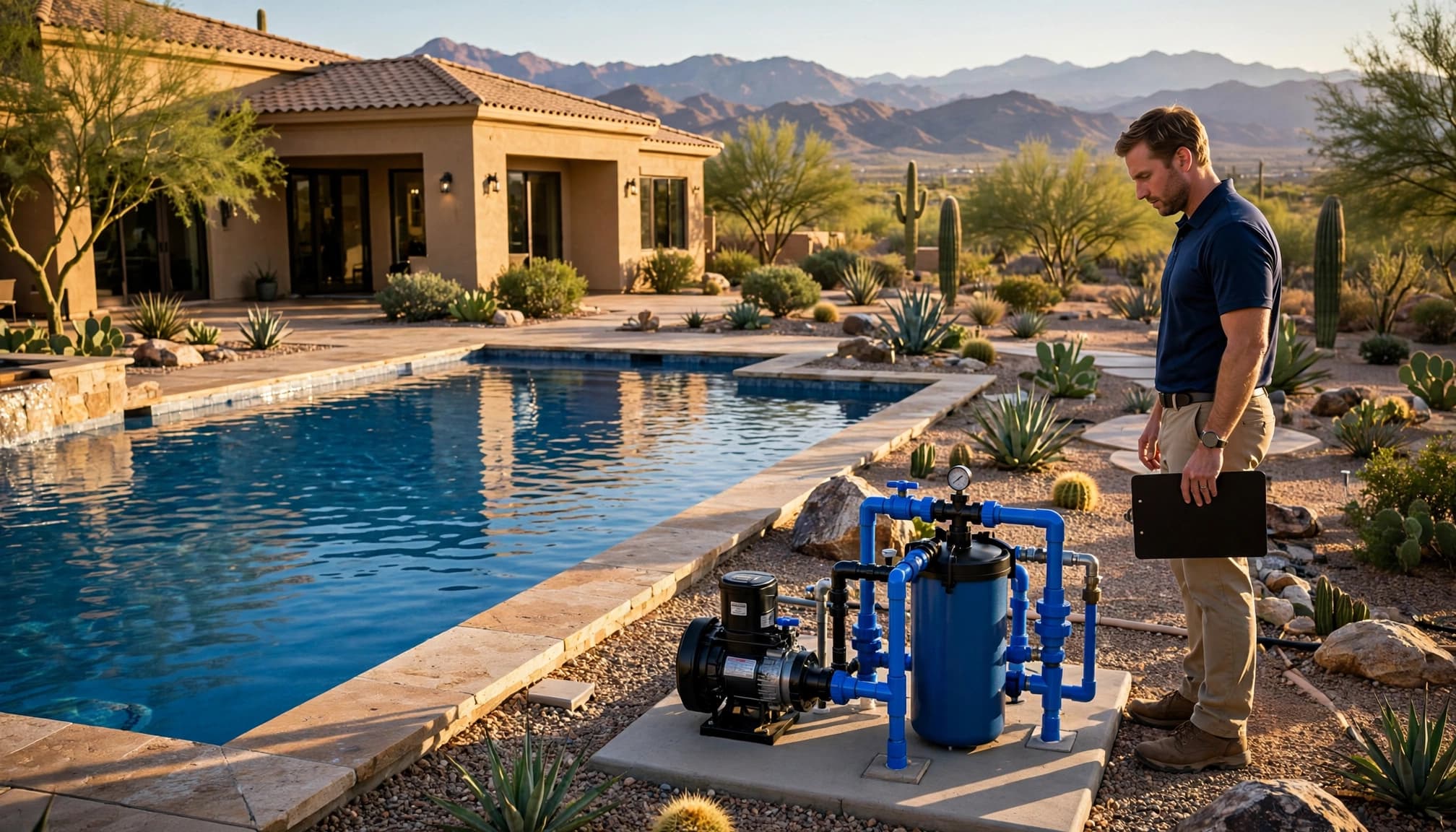
Ask whether each feature was tested under normal operation and whether inaccessible equipment was excluded. Ask the seller to have the system running before the inspection. The evaluation gets a lot less useful when the pump is off, the heater is locked, or the equipment pad is buried behind patio furniture and mystery storage bins.
Investing in a quality Phoenix pool inspection is an investment in your future.
An attached spa needs separate spa inspections and operational testing. Confirm that water diverts correctly, jets operate, the spa heats, and the spillway works if there is one.
Don’t underestimate the value of a solid Phoenix pool inspection.
Verify Phoenix pool barrier and gate rules
Safety barriers are where buyers can get surprised. A swimming pool fence may look fine to an adult and still fail to protect a small child.
The City of Phoenix pool policy requires a permanent, non-climbable exterior barrier at least five feet high. The City says there is no exception to that exterior fencing rule, and this pool barrier standard applies within Phoenix.
Check the exterior fence and gate first
Walk the entire perimeter. Check the exterior fencing for climbing hazards near the fence, damaged sections, loose posts, wide gaps, and gate problems. A non-climbable fence should not provide footholds or nearby climbing aids.
Phoenix requires gates to be self-closing and self-latching. They must open outward, away from the pool area. The latch needs to be at least four and a half feet above the ground, or otherwise inaccessible to small children. Fence openings must be less than four inches. These are the key safety parameters to verify.
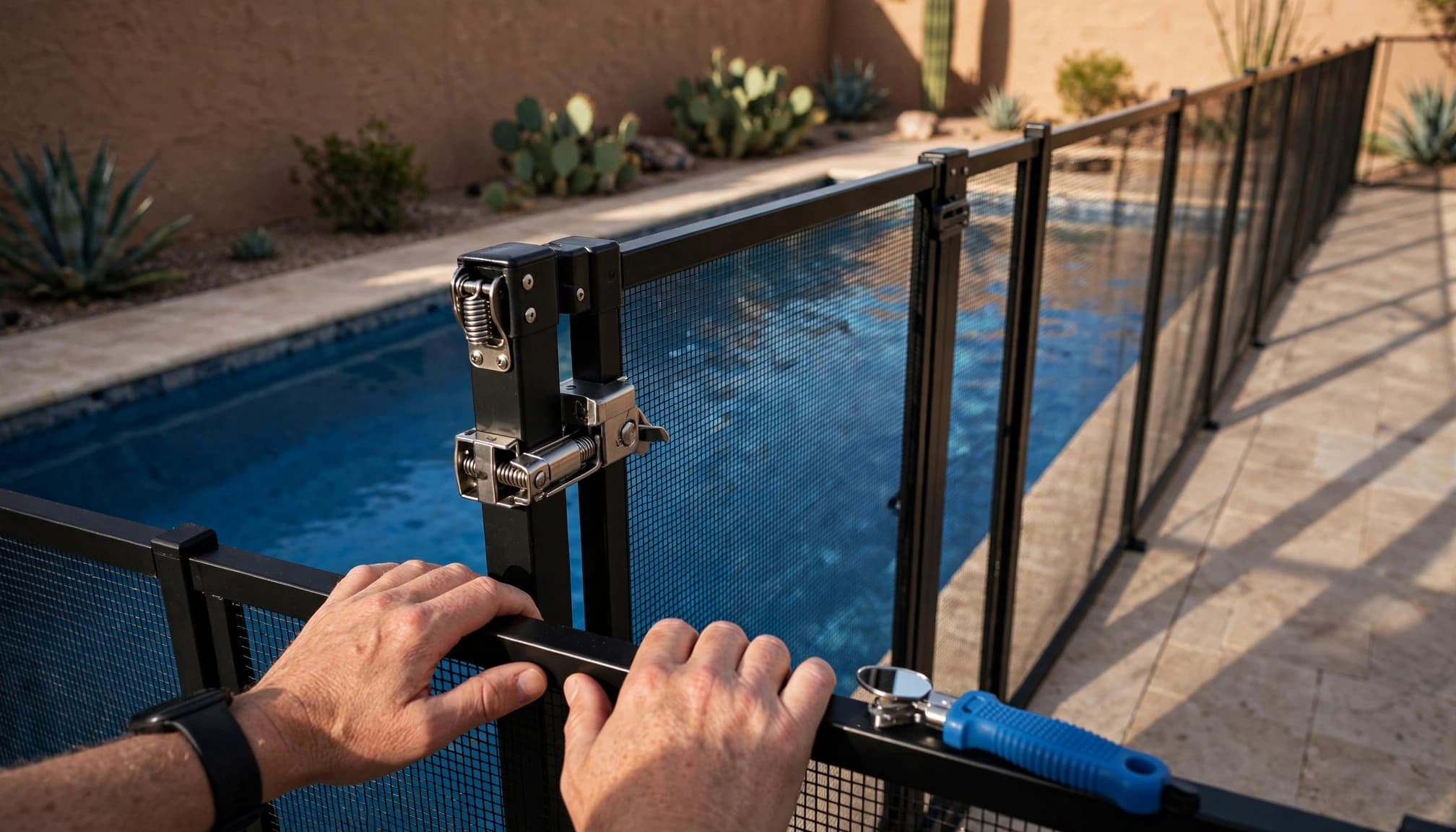
A gate that closes when you give it a hard shove is not the test. It needs to close and latch from a normal open position, every time.
Understand interior barriers and older pools
Most Phoenix pools also need interior barriers between the home and the water. The City allows several approaches, including a permanent barrier, compliant doors and windows when the home forms part of the pool enclosure, or an approved safety cover for a smaller spa or hot tub.
There is a narrow exception for a single-family home with a pool built before May 4, 1990, when every occupant is older than six. That exception doesn’t remove the exterior fencing requirement. The property still needs a non-climbable fence around the outside.
The City’s residential pool barrier information is the place to start if a fence has been altered, a permit question comes up, or you plan changes after closing. A pool inspector can flag concerns, but the City determines compliance with its rules.
A Paradise Valley or Scottsdale property may fall under a different local jurisdiction. Confirm the rule and permit history with the city or town that governs that address. Mailing addresses can be sneaky around 85254.
Spot pool problems that can change your offer
Not every concern needs a repair request. Sort each finding as a maintenance item, a specialist evaluation, or a potential deal-changing expense. That decision can affect your offer, closing plans, or willingness to proceed.
Treat leaks and structural movement seriously
Water loss is common in the desert, but frequent filling may point to more than evaporation. Wet soil near the equipment, recurring algae in one area, low water at the skimmer, and air bubbles through the returns deserve follow-up.
Visible structural cracks, severe deck movement, or separation at the coping need closer review. Ask for a specialist evaluation and a written repair scope during the inspection period. Don’t wait until you own the problem.
Don’t overlook electricity and drainage
Pool equipment combines water and electricity, which is a lousy place for shortcuts. Check the electrical system for damaged wiring, missing covers, poor bonding, corroded connections, unsafe outlets, faulty lighting, and other equipment safety concerns.
Also look at drainage. A backyard should move water away from the house and equipment. Decks that slope toward the home, standing water at the equipment pad, or drainage problems deserve attention before you waive the contingency.
The boring stuff is where expensive surprises hide. That applies to side yards and pump pads just as much as attics. Before waiving the contingency, obtain a specialist quote or repair scope for any concern that could change your offer or closing decision.
Use water quality testing as a useful snapshot
Clear water is nice, but it doesn’t prove water quality is balanced. A qualified evaluator may test the water on site, but confirm that service in writing because testing scopes vary.
Know the reference ranges
Arizona’s public and semipublic pool rules call for a pH level between 7.2 and 7.8 and a chlorine level between 1.0 and 3.0 parts per million. For authoritative Arizona guidance, review the Arizona Department of Health Services Arizona pool water-quality regulation.
Those figures are useful safety parameters. Desert evaporation can concentrate chemicals in a residential swimming pool. A pH level and chlorine level can also change with weather, use, and treatment. A private pool’s pH level is not subject to an automatic public-pool pass-or-fail determination.
Ask what the readings may be telling you
Low sanitizer, cloudy water, scale, algae, or a chemical odor can point to neglected maintenance, poor circulation, treatment timing, or equipment problems. It might also be a short-term issue after a storm, a pool party, or a recent treatment.
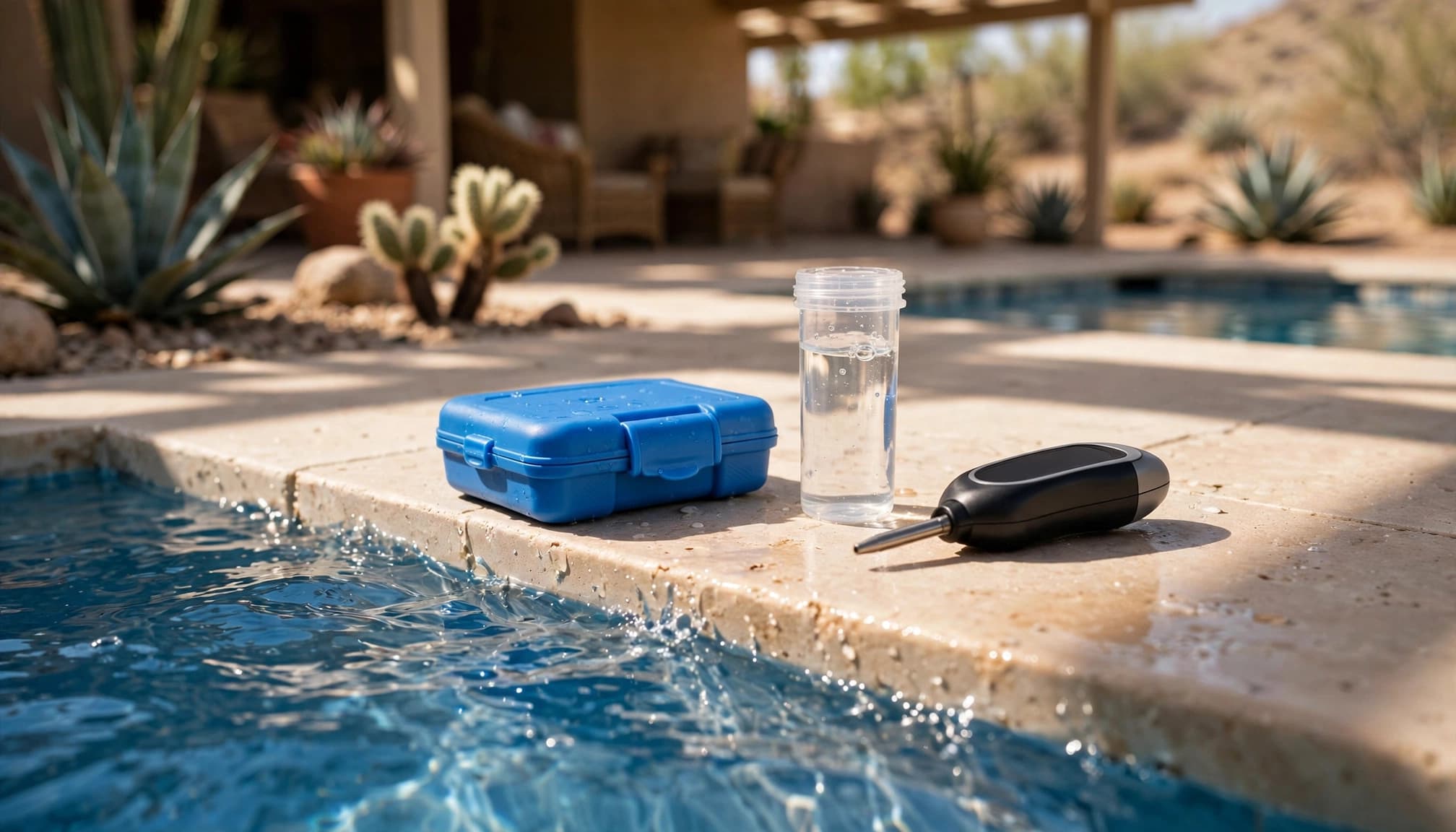
I wouldn’t walk away from a house over one water reading. I’d ask for recent service records that document water quality and confirm the equipment was operating during testing.
Budget for the inspection and hire the right person
A pool inspection can cost about $100 for a basic review or several hundred dollars for a larger, more complex setup. Local estimates vary by scope, equipment, and site conditions.
Know what changes the price
A simple pool with a pump and filter, basic controls, and no special features usually costs less to inspect than a property with a heated spa, salt system, slide, fountain, or extensive automation.
Some local companies publish rates around $175 to $450. Others charge more for estate pools, integrated spas, or feature-heavy backyards. Leak testing is often a separate service, not a free add-on.
Compare each pool inspector’s scope, credentials, insurance, and experience before booking. Verify that a certified pool inspector has relevant training, but remember that no single certification is required statewide.
Get a written quote covering the pool, attached spa, heater, salt system, automation, water features, leak testing, photos, report delivery, and exclusions. Ask whether fountain inspections are included. This prevents the classic surprise where you expected every feature to be reviewed.
Ask about independence and reporting
I prefer a pool inspector who doesn’t sell the repair services recommended in the same evaluation. That doesn’t make someone dishonest if they also repair pools. It simply gives you a cleaner second opinion through independent inspections.
Ask these questions before you book:
- Will you inspect the pump and filter, spa, heater, electrical system, and water features?
- Do you perform leak testing, or refer that work to another company?
- Will I receive photos, operating observations, exclusions, repair recommendations, and a written inspection report?
- Do you sell repairs or receive referral fees from repair companies?
- Can you explain which findings are urgent, routine maintenance, or likely major expenses?
- Will you provide a digital report, and when will it be delivered?
Share the findings and your deadline with the real estate professionals already involved. A clear evaluation gives you time to negotiate, seek specialist quotes, or move forward with clear expectations.
Frequently asked questions
Do all Phoenix pools need an interior barrier?
Most do, but a limited exception may apply to a single-family home with a pool built before May 4, 1990, when all occupants are older than six. A fence around the property is still required.
Does a standard pool inspection include the spa and water features?
Sometimes, but don’t assume. Ask whether the spa, heater, fountains, slides, pop-ups, waterfalls, and automation controls are included. For spa inspections, confirm the written scope before scheduling.
Can a general reviewer inspect the pool?
A home inspector can identify visible concerns, but a dedicated pool inspector usually evaluates equipment, operation, surfaces, and pool-specific risks more closely. A general review shouldn’t replace that specialist assessment.
Does water testing prove the pool has good water quality?
Not by itself. A single pH level or chlorine level reading is only a snapshot. Consider it with circulation, service records, and visible conditions.
What is the biggest pool red flag before closing?
There isn’t one clear winner. Unexplained water loss, structural cracks, damaged gates, failing equipment, and unsafe wiring all deserve prompt follow-up.
A calm inspection beats a costly surprise
A pool should make life better, not turn your first summer in the house into a repair project. Before your deadline runs out, read the report, request specialist evaluations, and compare repair quotes.
Share documented findings and key deadlines with the real estate professionals already involved in the transaction. Then negotiate repairs or a credit, and decide whether to proceed before waiving contingencies. If an excluded spa affects your budget, arrange spa inspections before closing.
I’ve watched buyers make smart decisions by slowing down and asking questions when something does not add up. Clarity beats pressure every time.